Public Site
Open Regels Nederland is the public knowledge base of the Province of Flevoland. It publishes public information only — no personal data is processed, and no login or account is needed. It is for anyone: residents, businesses or officials from other organisations who want to look up the same regulations, products, processes and concepts that a Flevoland civil servant sees in the werkomgeving.
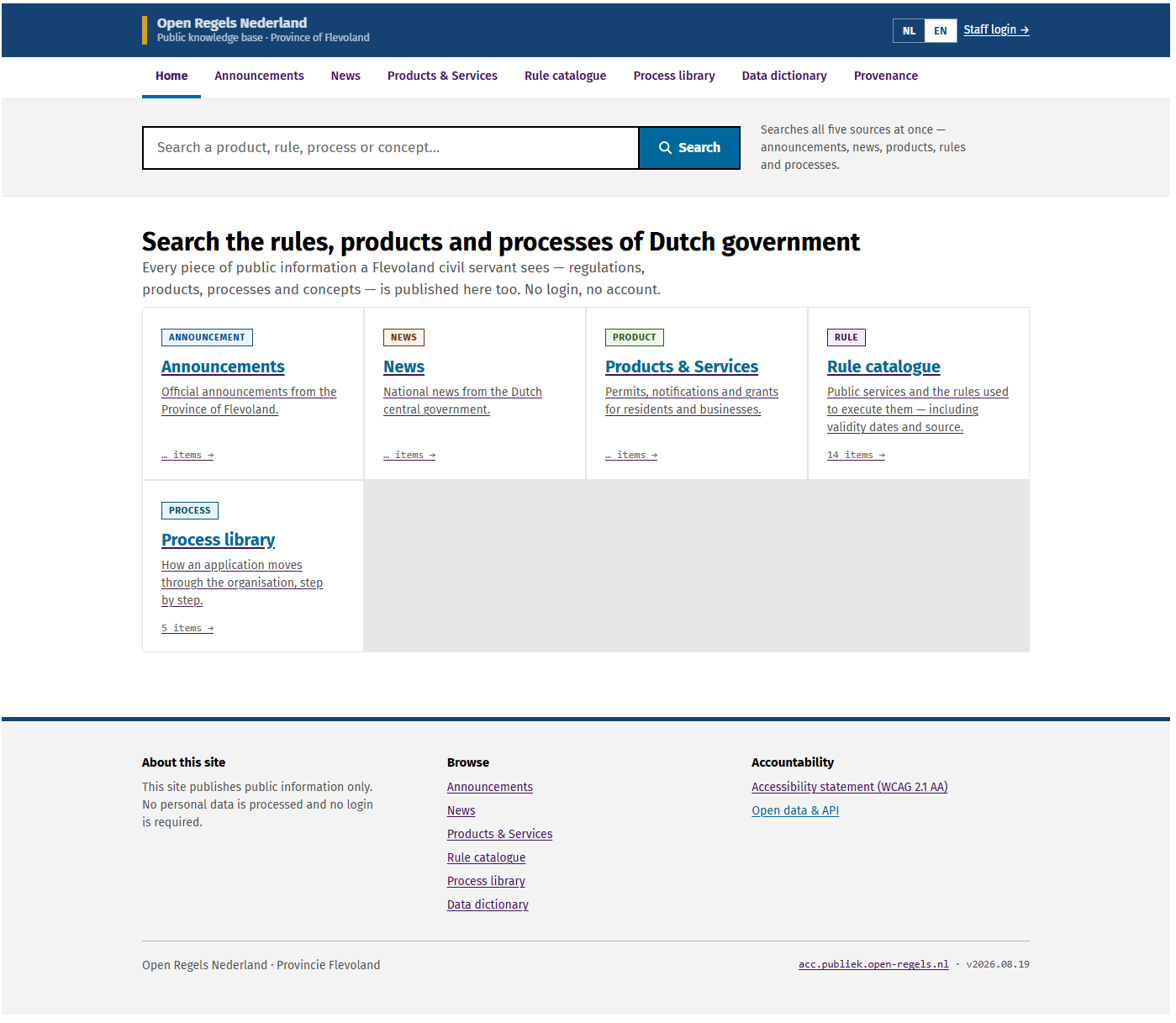
Combined search
A single search box queries all five sources at once — announcements, news, products, rules and processes.
Five sources
| Source | Description |
|---|---|
| Announcements | Official announcements from the Province of Flevoland. |
| News | National news from the Dutch central government. |
| Products & Services | Permits, notifications and grants for residents and businesses. |
| Rule catalogue | Public services and the rules used to execute them, including validity dates and source. |
| Process library | How an application moves through the organisation, step by step. Each process carries a status label — see below. |
Every deployed process, with its status on it
The process library lists every process deployed to a public-facing board,
whatever state it is in, and each one shows its status — example, wip or
e2e — beside its name. The label appears in the listing and in search results,
not only on a process's own page, so you can see at a glance that something is a
worked example or still in progress without opening it.
The label is always written out as text rather than signalled by colour alone.
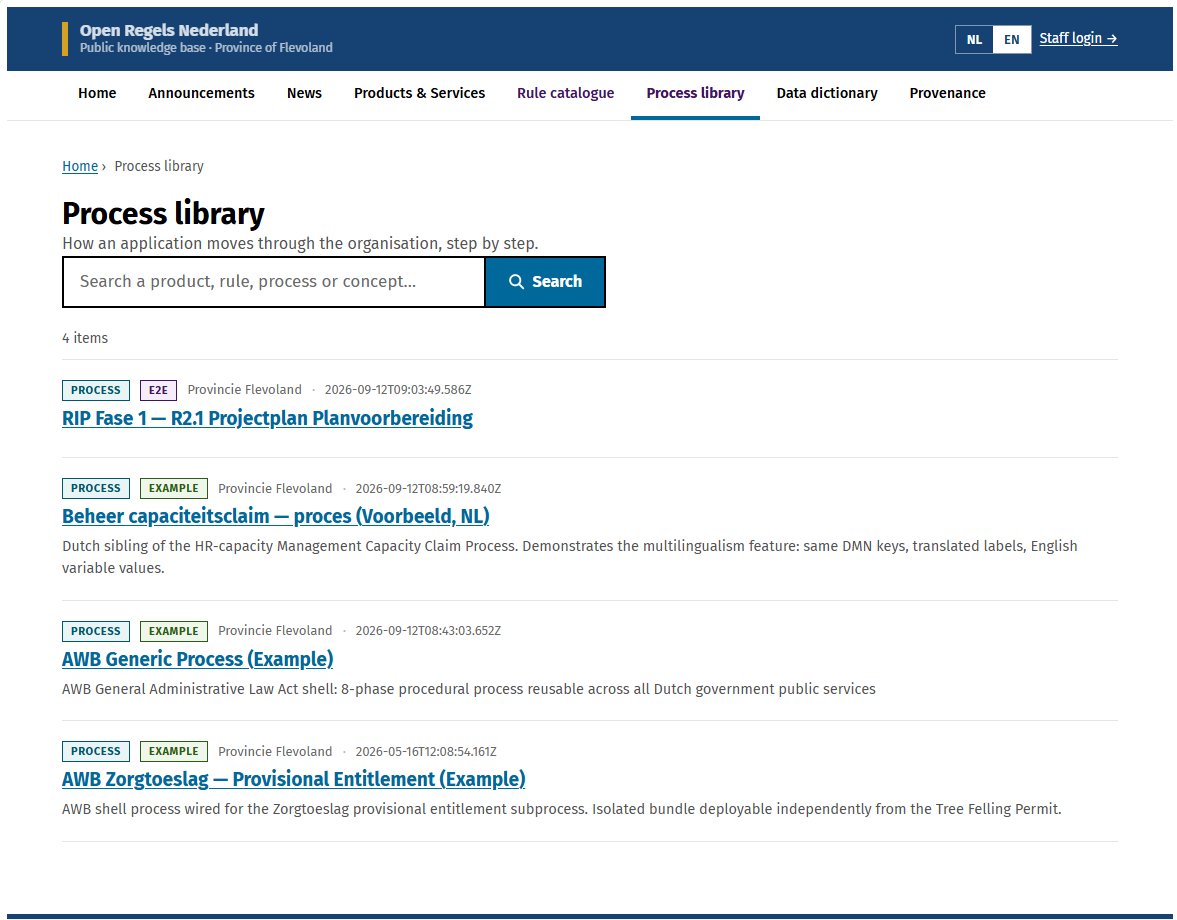
If you looked here before September 2026 and found it empty
You were not missing anything and nothing was hidden from you: production listed no processes at all. The library had been filtering on a status value the underlying catalogue cannot hold, so nothing ever passed it. It now filters on which board owns a process and nothing else.
A rule's concepts, split into input and output
Open a rule from the search results and scroll to its concepts. They are no longer one alphabetical row of chips. The heading still names the section and counts every concept of the service, and below it the chips are divided into two labelled groups, each carrying its own count:
- Invoer — gegevens die de regels nodig hebben. The values the rules take in before they can decide anything.
- Uitvoer — wat de regels bepalen. What comes out: the entitlements, amounts and decisions the rules arrive at.
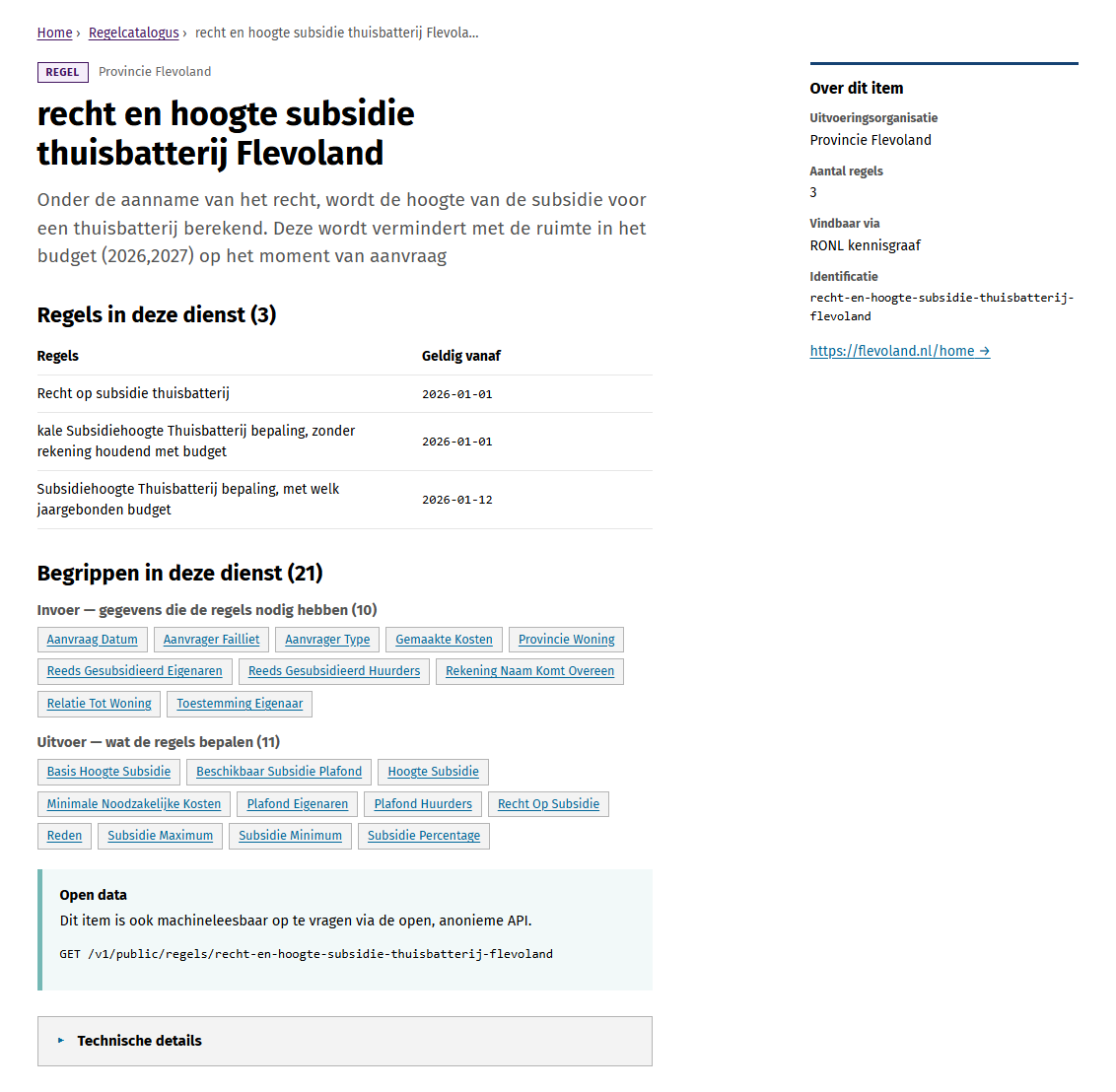
Every chip still links out to the term in the shared vocabulary, exactly as before.
Some concepts sit in a third group, and that is not a fault
The division comes from the knowledge graph. Where the graph does not say which side a concept belongs to, the concept is shown in a group of its own rather than dropped or guessed at — so nothing goes missing from the count.
Two other things are worth knowing if a page looks different from this one. The grouping is per service, not per rule: where a service's rules all hang off one decision model, a value reads as an output of the service even if the particular rule you are reading consumes it. And a page served by a tier that has not yet been updated shows the single undivided row it always did.
Further sections
The top navigation also has Data dictionary and Provenance, alongside an NL/EN language toggle and a Staff login link across to the werkomgeving.
Accountability
The footer's "Accountability" column links to the Accessibility statement (WCAG 2.1 AA) and Open data & API.
Which build you are looking at
The foot of every page ends with a small monospace line naming the site, the release, and the build it was made from. On production on 12 September 2026 it read:
The address is the environment you are actually on — the acceptance copy shows its own address there. The v… is the release. build … is the first seven characters of the commit the site was built from, and the #… after it is the number of the deployment run, which is what tells two builds of the same release apart. Hovering the build shows the full commit hash, so it can be copied into a bug report. A copy of the site that did not come from a deployment reads local build instead.
Acceptance runs alongside production
The site is live at publiek.open-regels.nl. An acceptance copy runs at
acc.publiek.open-regels.nl, where a release is tried before it is
promoted. The footer line above is how to tell which of the two you have
open.